
Property taxes in Ross County are based on the assessed value of your property. If you believe the Ross County Auditor has valued your property higher than its actual market value, you have the right to file a Property Value Complaint. This process allows you to request a review or adjustment of your property’s value to ensure you are paying a fair amount of tax.
Understanding What a Property Value Complaint Is
A property value complaint is a formal request made by a property owner or other eligible party to the Ross County Board of Revision (BOR). It challenges the market value assigned to a property by the Ross County Auditor’s Office.
The purpose of this complaint is not to dispute tax rates but to correct the assessed value if it does not accurately reflect the property’s true market price.
Why You Might File a Property Value Complaint
Valid reasons for filing a complaint include:
- The property’s assessed value is higher than its actual market value.
- The property suffered damage (fire, flooding, or structural loss) that reduced its worth.
- Comparable homes in the same neighborhood are valued lower.
- The property has not been maintained or improved but its value increased unreasonably.
Filing a complaint gives you an opportunity to present evidence and request a fair reassessment.
Types of Property Value Complaints in Ross County
The Ross County Board of Revision accepts three main types of property value complaints under Ohio law:
1) Owner’s Complaint
Filed by the property owner or taxpayer who believes the assessed value is incorrect. The owner submits evidence to support a lower valuation.
2) Third-Party Complaint
Filed by another party, such as a school district or neighboring property owner. A school district might file this if they believe a property is undervalued and it affects tax revenue.
3) Counter-Complaint
Filed in response to an existing complaint. For example, if a property owner files to reduce the value, the local school district may file a counter-complaint to maintain or increase the value. Both sides then present their case at a hearing before the Board of Revision.
Filing Period and Deadlines
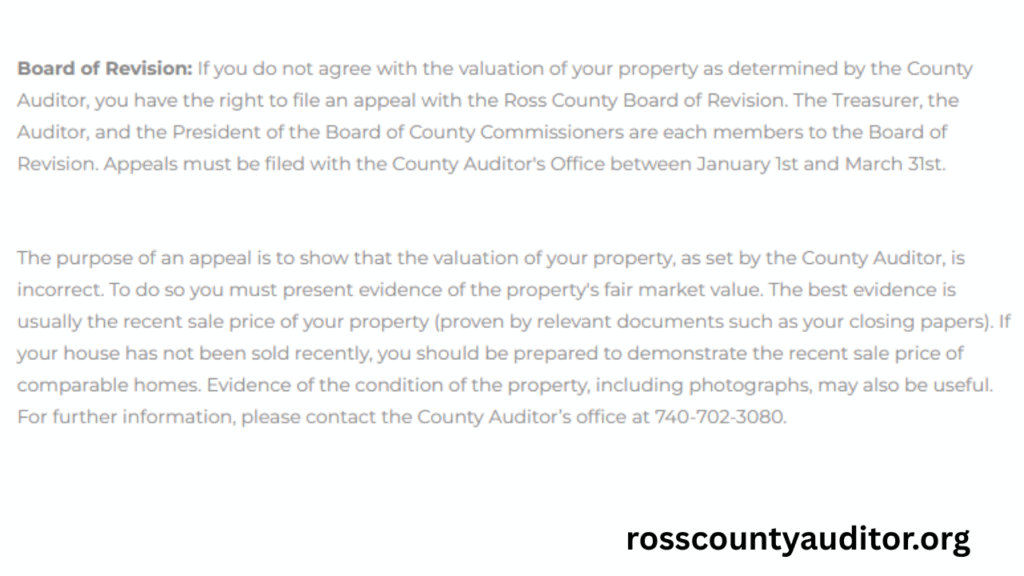
The filing period for property value complaints in Ross County runs from January 1 through March 31 of each year.
Complaints submitted after March 31 are not accepted for that tax year. Filing on time is essential to preserve your right to appeal.
Required Forms
You will need the DTE complaint forms:
- DTE-1 – Complaint Against the Valuation of Property
- DTE-1M – For Manufactured or Mobile Homes
- DTE-2 – For Assessment of Property Other than Market Value
- DTE-26 – For Destroyed or Damaged Property
Tip: Always download the latest version from the Ross County Auditor site.
Step-by-Step Guide to Filing
Step 1: Obtain & Complete the Form
Download DTE-1 (or relevant form) from the Ross County Auditor’s Forms page or pick it up in person. Fill in all required details, including parcel number, owner info, and your proposed value.
Step 2: Gather Supporting Evidence
Evidence may include:
- Recent independent appraisal
- Sale documents showing lower sale price
- Photos of property damage or needed repairs
- Comparable sales from similar properties
- Repair estimates or contractor quotes
- Sketch or plat showing lot boundaries or zoning notes
- Income/expense statements for rental or commercial properties
Step 3: Submit the Complaint
Submit the completed form in person or by certified mail to the Ross County Board of Revision at the Auditor’s Office.
Ross County Auditor Contact:
2 N Paint St, Suite G, Chillicothe, OH 45601
Phone: (740) 702-3080
Auditor Website
Step 4: Wait for the Board of Revision Review
After submission, your case is scheduled for review. You may receive a notice to attend a hearing, where you will have an opportunity to explain your position and present evidence.
Step 5: Attend the Hearing (if required)
Bring all supporting documents. Present your case clearly to the Board of Revision. School districts or other parties may also present evidence.
Step-by-Step Checklists for Filing & Hearing
Filing Checklist (Before Submission)
✅ Download the correct DTE form (DTE-1, DTE-1M, DTE-2, DTE-26)
✅ Fill in all property details: owner name, parcel number, address, current and proposed value
✅ Provide detailed reason for requesting change
✅ Gather all supporting evidence (appraisal, sale documents, photos, comparable sales, repair estimates)
✅ Organize evidence clearly (number/label exhibits)
✅ Verify all dates and signatures
✅ Notarize the form if required
✅ Make at least one copy for your records
✅ Confirm all attachments are included
✅ Double-check parcel number matches Ross County property records
Hearing & Follow-Up Checklist
✅ Confirm hearing date, time, and location
✅ Prepare a short summary of your argument
✅ Bring all supporting documents (appraisal, photos, comps, repair estimates)
✅ Organize exhibits for easy presentation
✅ Take notes during hearing for future reference
✅ Review the Board’s written decision carefully
✅ Check if a tender payment is needed for taxes
✅ If disagreeing, prepare to appeal to Ohio Board of Tax Appeals or Court of Common Pleas
✅ Observe appeal deadlines (usually 30 days)
Step 6: Receive the Decision
The Board of Revision will notify you in writing once a decision has been made. They may:
- Reduce your property value
- Keep it the same
- Increase it (in rare cases)
What Happens After the Decision
If you agree with the Board’s decision, your new property value will be updated in county records and reflected in your next tax bill.
If you disagree, you may appeal the decision to the Ohio Board of Tax Appeals or the Court of Common Pleas within 30 days of receiving the notice.
Common Mistakes to Avoid
- Filing after the March 31 deadline
- Submitting incomplete or unsigned forms
- Failing to provide credible evidence
- Comparing your property to non-similar homes
- Not attending the hearing if called
Avoiding these errors ensures your complaint is valid and reviewed properly.
How Long the Process Takes
The review process typically takes several months, depending on the number of complaints filed that year. The Board aims to resolve all cases before the end of the tax cycle so any adjustments apply promptly.
Conclusion
Filing a property value complaint in Ross County is a structured, fair process that allows property owners to ensure accurate taxation. By preparing strong evidence, submitting DTE Form 1 on time, and following all procedural requirements, you can present a clear and convincing case for a fair property assessment.
If you are uncertain about the valuation or complaint process, consult the Ross County Auditor’s Office or a licensed real estate appraiser for professional guidance.
FAQs
Where can I file a Property Value Complaint?
You can file your complaint with the Ross County Board of Revision, which operates under the Ross County Auditor’s Office. The form is available online on the Auditor’s official website or in person at their office.
Which form do I need to complete?
Complete DTE Form 1 – Complaint Against the Valuation of Real Property.
What evidence do I need to provide?
A recent property appraisal report
Sale documents or closing statements
Market comparison data for similar homes
Photos showing property damage or condition
What is the filing deadline for a Property Value Complaint?
The filing period runs from January 1 through March 31 each year.
How long does the Property Value Complaint process take in Ross County?
The review process usually takes a few months, depending on the number of complaints filed that year. After your hearing, the Board of Revision generally issues a written decision within 60 to 90 days. Once approved, any change in your property value will be reflected in your next tax bill.